
This conversation is useful for Russian brands looking for production partners in India, Indian manufacturers interested in Russian orders, and organisations that could coordinate the relationship on both sides. Alliance × Beinopen, BSL and Stylon discussed a limited first pilot: one real request from a Russian brand, one appropriately specialised Indian factory, a visible production process and a documented result before any attempt to scale the model.
The meeting continued the proposal described in “Alliance × BSL: the Russia–India ‘Reference Factory’ track”. The participants did not agree on a finished commercial model. They tested whether their networks and systems could complement one another and identified what each side would need before a first project.
Participants
- Alexey Bazhenov — Alliance × Beinopen, initiator of the pilot and architect of the cooperation model;
- Konstantin Krivoshein — CEO of Stylon, responsible for the production-data and ERP layer;
- Raman Dutta — Chairman of Brands & Sourcing Leaders Association (BSL) and head of a sourcing business;
- Divya — BSL team, meeting coordination.
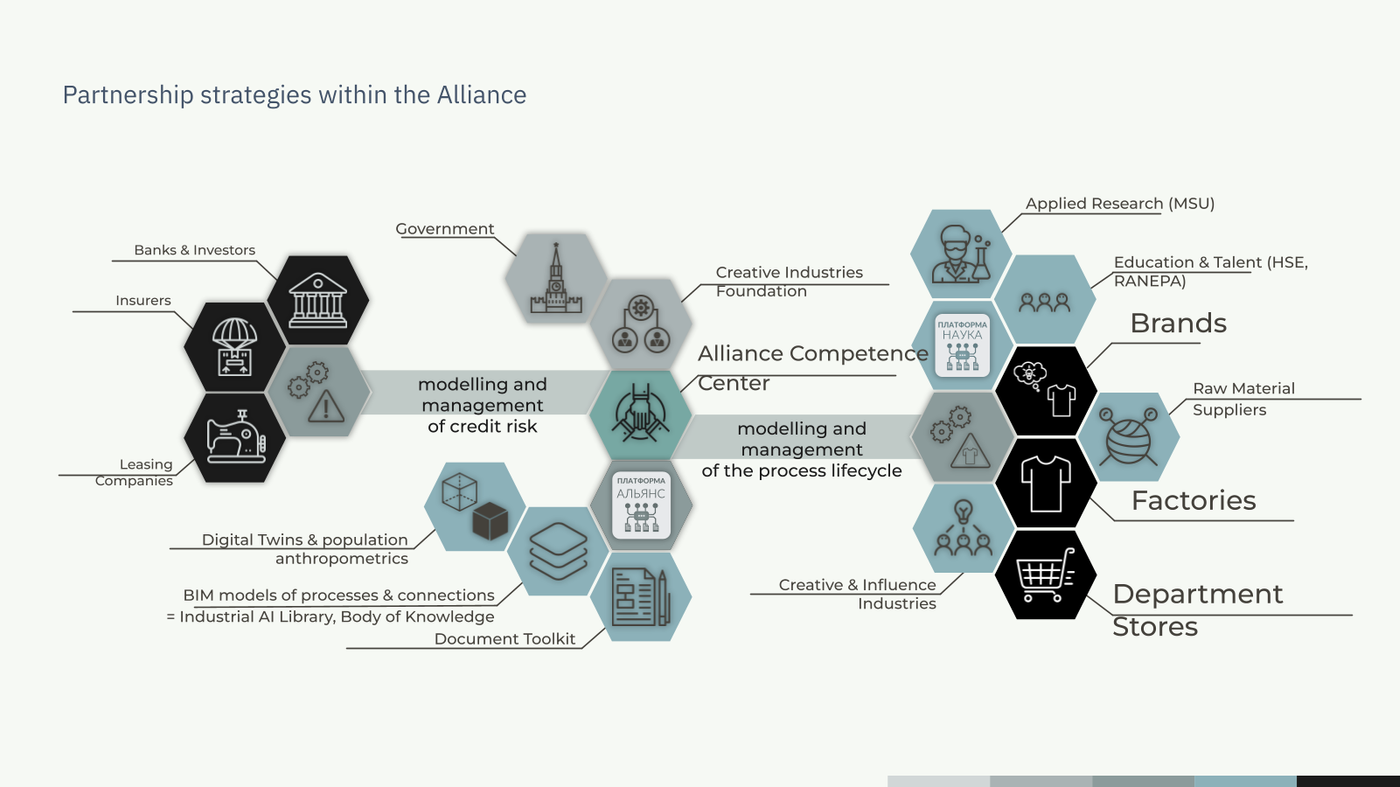
Alliance architecture presented during the meeting.
Alliance proposes starting with one real order
Alexey Bazhenov opened the conversation by explaining that Alliance × Beinopen brings together brands, factories, department stores and other professional roles. Its function in this project is not to act as a sourcing agent or take a percentage from a production order. The Alliance wants to create a repeatable coordination protocol in which participants can see how a request becomes a calculation, a pilot and a verified case.
The proposed starting point was deliberately small: one Russian brand publishes a concrete request, one Indian factory responds, and the parties work directly in a shared project chat. The Alliance follows the process, helps the participants clarify requirements and records what succeeded, what failed and which rules need to be improved. If the first case produces a reliable result, the same protocol can be tested with more brands and manufacturers.
Alexey described this as mutual exchange rather than one-way export. Russian brands receive access to suitable production capacity; Indian manufacturers receive specific requests rather than general promises of demand. Both sides contribute to a coordination protocol that can later support repeated orders.
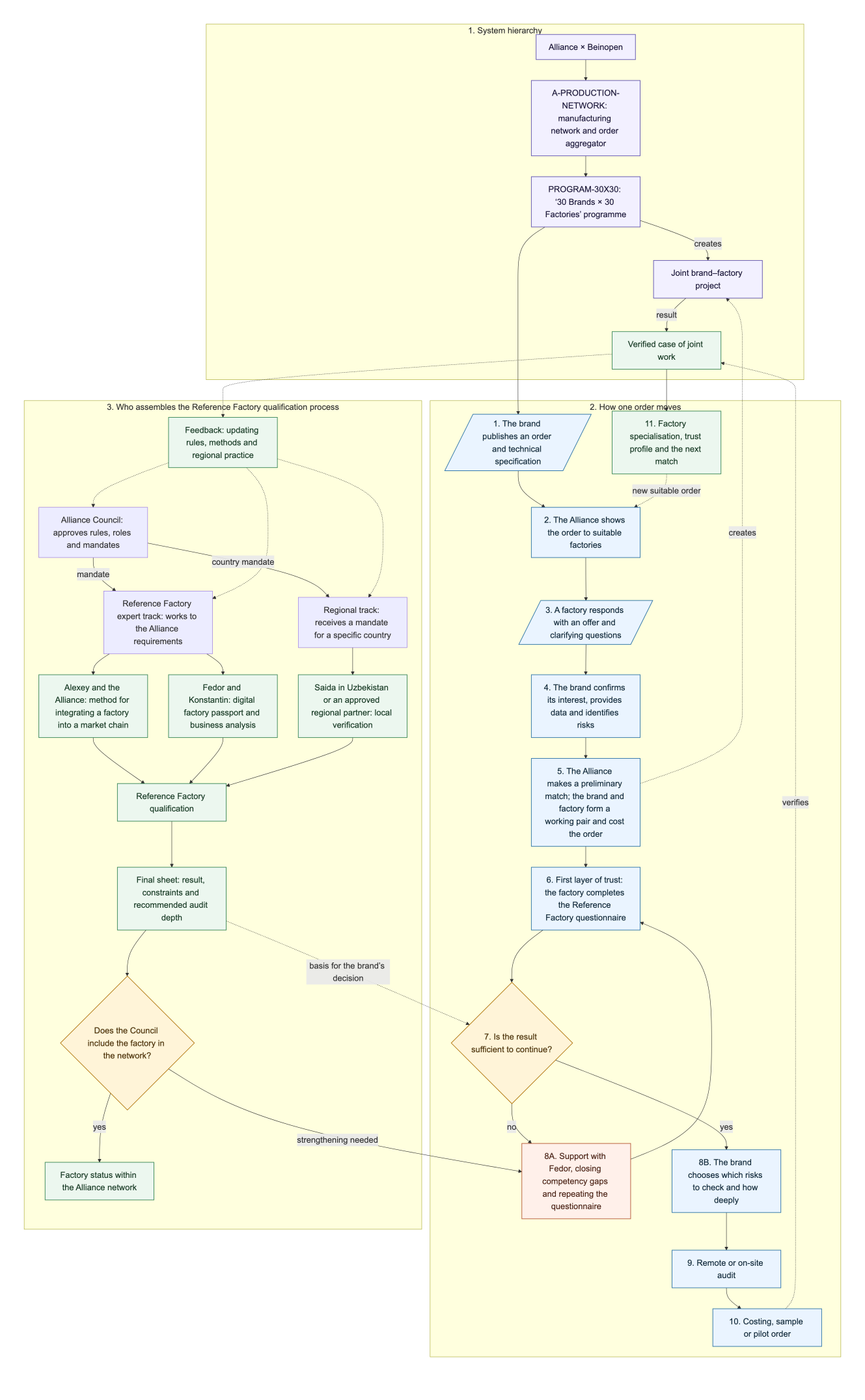
The 30 × 30 system map: system hierarchy, the flow of one order and the Reference Factory qualification process.
BSL asks for product categories before selecting factories
Raman Dutta said that BSL brings together approximately 450 CEOs, including sourcing companies, brands and Indian offices of international companies. He also described his own sourcing practice and experience with Inditex and other European customers. These figures and client references were presented by Raman during the meeting and have not yet been independently verified by the Alliance.
He confirmed that BSL could help identify Indian manufacturers for both large and small quantities. The essential input, however, is not a general list of Russian brands but a description of what they actually need: product category, quantity and other initial requirements. A denim order, knitwear, underwear, shirts, jackets or sweaters require different specialised factories.
When Alexey asked about small batches, Raman said that his network includes manufacturers working with quantities of roughly 20–200 pieces, usually when they receive a complete collection across several styles. He therefore asked the Alliance to send the product categories and current requests already available rather than wait for a complete Russian market map.
Raman also asked about payment terms. Alexey answered that the brand and factory negotiate payment directly. This preserved an important boundary of the proposed model: the Alliance supports the relationship and reduces uncertainty but does not replace the commercial parties to the transaction.
Stylon proposes a transparent production-data layer
According to Konstantin Krivoshein, Stylon is an ERP production system used by more than 200 garment, knitwear and textile enterprises in seven CIS countries. He explained that the system covers the production chain from product development and planning through cutting, sewing and payroll to labelling, shipping and calculation of the real cost of an order. These figures and functions were presented by Konstantin during the meeting and were not independently verified by the Alliance for this protocol.
For an international project, Konstantin identified three especially important parameters: quality, delivery time and trustworthy information about the progress of an order. Stylon can collect operational data — for example, how much fabric has been cut and how many units are at each production stage — and provide it to a partner platform. It can also support Russian marking requirements, including the “Chestny ZNAK” system.
Konstantin proposed exploring a common data-exchange protocol between brands, factories, BSL, the Alliance and production systems. He offered to send a presentation and continue the technical conversation separately.
Raman saw a substantial Indian market for production ERP systems but noted that India already has many local solutions. Before discussing implementation, BSL would need to understand Stylon’s pricing, advantages and compatibility with existing factory systems. No decision on ERP integration was made.
Raman describes a transparent sourcing model
Alexey asked whether brands distrust sourcing companies because an intermediary can hide the factory price and increase its own margin. Raman disagreed with this as a general description of the modern market. In his model, manufacturers and clients know the sourcing company’s percentage; the fee has to remain reasonable because long-term cooperation makes hidden or excessive margins unsustainable.
This exchange clarified an important difference that remains to be designed rather than erased. The Alliance does not plan to earn a percentage from each order. BSL combines an association role with commercial sourcing expertise. The participants need to decide how their contributions complement one another, how the first pilot is financed and how the parties make money without obscuring factory economics from the brand.
Alexey asks to show cases from the brand’s side
Raman offered to share his company presentation, product examples and customer portfolio. Alexey stressed that manufacturers and sourcing organisations are trusted more easily when a case shows the original request, what the factory produced, how the process was organised and what the customer received. A list of logos is less useful than a reconstructable example of cooperation.
Raman replied that his website shows products supplied to stores and that his portfolio includes both large European groups and small boutiques. He agreed to share the materials so the Alliance can understand how to present this experience to Russian brands.
For the first Russian demand pool, Alexey referred to orders already collected in the “30 brands × 30 factories” pilot and to product categories ranging from T-shirts and knitwear to shirts, jackets and other outerwear. He explained that the Alliance is particularly interested in brands that are large enough to place a real order but still need a repeatable international production route.
What was agreed
- Alliance × Beinopen will send BSL the product categories and real requests already available from Russian brands.
- Raman Dutta will use those requirements to identify potentially suitable Indian manufacturers rather than send an undifferentiated factory list.
- Raman will share his company and case materials; Konstantin will share information about Stylon.
- The parties agreed to continue the discussion during Raman’s October visit to Moscow and to keep operational contact through their existing channel.
What remains open
- the exact Russian brand and Indian factory for the first pilot;
- qualification criteria and who validates an Indian factory locally;
- the commercial model and how each party is paid;
- whether Stylon or another system supplies the production-data layer;
- the minimum set of shared order data and the limits of access to it;
- payment, logistics, quality control and dispute procedures for the pilot.
Next step
The next conversation should begin with one or several product requests from Russian brands (check here current orders https://alliance.beinopen.ru/post/4548/) and a small number of manufacturers selected by BSL for those exact categories. This will allow the participants to move from a broad partnership proposal to engineering the requirements of the first Russia–India production pilots.
